
Uncover every risk
before you sign
Due diligence services for UAE M&A, investment & joint venture transactions
Due diligence in the UAE is the structured process of independently verifying a target company's financial position, legal standing, tax compliance, and operational integrity before a transaction completes. It is essential for acquirers, investors, joint venture partners, and lenders operating in a market where regulatory obligations span MOHRE, FTA, SCA, CBUAE, and 45-plus individual free zone regulators — each maintaining separate compliance records not visible to a buyer without a formal investigation. Without it, you inherit not just a business but every undisclosed liability, penalty, and regulatory gap that comes with it.

21+
Years in UAE advisory
11K+
Companies served
4.8★
Average client rating
700+
Verified Google reviews
Why due diligence is not optional in UAE transactions
The UAE's business environment spans mainland entities, 45-plus free zones, and a federal regulatory framework significantly restructured between 2021 and 2023 — with the introduction of Corporate Tax under Federal Decree-Law No. 47 of 2022, the overhaul of the Labour Law under Federal Decree-Law No. 33 of 2021, and the implementation of Economic Substance Regulations and UBO disclosure requirements under Cabinet Decision No. 58 of 2020. A target company operating across this period carries compliance obligations from multiple regulatory cycles. A buyer who does not verify each one inherits the consequences of every gap.
Undisclosed tax liabilities
VAT returns may have been filed incorrectly since registration became mandatory in 2018. Corporate Tax obligations effective from June 2023 may not be reflected in the accounts. FTA penalties accumulate silently — a company can carry AED 50,000 or more in outstanding FTA liability with no visible indication on its balance sheet unless specifically investigated.
Labour and WPS compliance gaps
MOHRE maintains a compliance record for every UAE mainland establishment. Outstanding WPS violations, under-provisioned EOSB, and incorrectly classified employment contracts under the new limited-term framework represent real liabilities a buyer absorbs. The EOSB liability alone for a 30-person company with three years of miscalculation can run to AED 200,000 or more.
UBO and AML compliance failures
Cabinet Decision No. 58 of 2020 requires all UAE companies to maintain and file an Ultimate Beneficial Owner register. A company that has not updated its UBO register following shareholder changes carries an administrative fine exposure and potential AML compliance flags that can complicate the acquisition itself.
Free zone restrictions and licensing mismatches
Share transfers in free zone companies require prior approval from the free zone authority in most cases. Licensing activity mismatches — where a company has been conducting activities not covered by its licensed scope — are a separate but equally common issue that surfaces consistently in due diligence.
Six types of due diligence we conduct
Each stream is available independently or as part of a full multi-stream engagement. Scope is agreed upfront and fixed in the engagement letter.
Financial Due Diligence
Independent verification of historical financial performance, quality of earnings, working capital, and balance sheet integrity. We reconcile management accounts against audited financials, examine bank statements across all UAE accounts, and identify off-balance-sheet liabilities or related-party balances that distort the true financial picture. Applies the same substantive testing standards used in our statutory audit work, adapted to a transaction context.
Legal & Regulatory Due Diligence
Verification of corporate standing, ownership structure, contractual obligations, and compliance with the UAE Commercial Companies Law (Federal Decree-Law No. 32 of 2021). We review the MOA, shareholder register, board resolutions, material contracts, pending litigation, and government authority correspondence. For DIFC or ADGM entities, we verify annual filings, financial statements, and UBO notifications with the respective registrar.
Tax Due Diligence (VAT & Corporate Tax)
Covers three distinct UAE compliance frameworks: VAT (Federal Decree-Law No. 8 of 2017), Excise Tax where applicable, and Corporate Tax (Federal Decree-Law No. 47 of 2022). We examine VAT return history, reclaim positions, input tax recovery, FTA correspondence, CT registration status, and transfer pricing documentation for related-party transactions. Our corporate tax advisory and VAT advisory teams provide specialist input on complex positions.
Commercial / Market Due Diligence
Assessment of the sustainability of the target's revenue base, competitive positioning, and client concentration risk. We examine customer contracts for renewal clauses, key-person dependencies, and exclusivity arrangements that may not survive a change of ownership. For businesses operating under government contracts or Emiratisation quotas, we assess whether the commercial model remains viable post-acquisition given the target's specific licencing conditions and visa quota position.
Operational Due Diligence
Examination of internal processes, systems, and workforce structure that underpin financial performance. In the UAE context, this includes assessment of the MOHRE establishment card and visa quota capacity relative to actual headcount, WPS submission history, pending MOHRE inspections, IT systems, key supplier contracts, lease agreements with Ejari registrations, and operational dependencies that require specific attention during post-acquisition integration.
HR & Labour Compliance Due Diligence
One of the most consistently underestimated risk areas in UAE transactions. We review employment contracts against Federal Decree-Law No. 33 of 2021 — verifying limited-term format compliance, independent EOSB calculation under the current law, accurate leave provisioning, MOHRE compliance record, WPS submission history, Emiratisation quota status, and pending labour complaint filings. The total EOSB and accrued leave liability is calculated independently and compared to provisions in the accounts.

How our due diligence process works
Scope & Engagement Setup
2–3 business daysAgree the precise scope of each due diligence stream, depth of testing, and transaction context. Issue engagement letter and data room document request list. Fee, timeline, and deliverables confirmed in writing at this stage.
Document Collection & Data Room Review
5–10 business daysIssue comprehensive document request list structured by stream. Work with the target or their advisors to populate a secure data room. Log every document received and every gap — the gap register forms part of the final report. Missing documents at this stage are themselves a risk indicator.
Financial & Tax Analysis
5–8 business daysDetailed review of three to five years of financial statements, reconciled against bank statements and management accounts. Tax analysis runs in parallel — VAT position reconstructed from transaction data, CT exposure assessed, FTA correspondence reviewed. Positions carrying FTA audit risk are flagged.
Legal & Regulatory Verification
5–8 business days (concurrent)Verify corporate documents with DET (mainland), applicable free zone registrar, or DIFC/ADGM registrar. Check UBO register status, licencing conditions, activity scope, and sector-specific approvals (MOH, KHDA, DHA, SCA, CBUAE). Pending litigation identified through court records searches and management representations.
Risk Assessment & Red Flag Identification
2–3 business daysEvery finding assessed against a consistent risk framework — rated by materiality, likelihood of crystallisation, and the buyer's ability to mitigate or price the risk. Red flag items presented with a specific recommendation: walk away, renegotiate, seek indemnity, or proceed with eyes open.
Due Diligence Report & Advisory
2–3 days draft + 1 day presentationStructured report covering findings across all streams, risk register, and recommendations for each material finding. We present directly to the client and their legal advisors. For clients who identify grounds not to proceed, we can support any required company liquidation or wind-down process.
UAE-specific risk areas we investigate
Every UAE transaction carries risks specific to this regulatory environment. These six areas produce the highest frequency of material findings in our experience.
| Risk Area | What We Check | Relevant UAE Law / Authority |
|---|---|---|
| Labour & WPS Compliance | MOHRE establishment card status; WPS submission history (24 months); EOSB provision accuracy under Federal Decree-Law No. 33 of 2021; accrued leave balances; outstanding labour complaints; Emiratisation quota compliance | MOHRE (mohre.gov.ae); Federal Decree-Law No. 33 of 2021; MOHRE WPS framework |
| VAT & Corporate Tax Gaps | FTA registration status; VAT return filing history and accuracy; input tax recovery methodology; outstanding FTA assessments; CT registration and provision adequacy for financial years from June 2023; TP documentation for related-party transactions | Federal Tax Authority (tax.gov.ae); Federal Decree-Law No. 8 of 2017 (VAT); Federal Decree-Law No. 47 of 2022 (CT) |
| UBO & AML Compliance | UBO register filing status and accuracy; ownership changes not reflected in the register; AML policy documentation for entities with AML obligations; sanctions screening of principals | Cabinet Decision No. 58 of 2020; Federal Decree-Law No. 20 of 2018 (AML); Ministry of Economy (economy.gov.ae) |
| Trade Licence Validity & Activity Scope | Current licence status with the relevant authority; whether commercial activities match the licensed activity scope; outstanding fines or renewal deferrals; free zone licence renewal history | DET Dubai (det.gov.ae); applicable free zone authority; Federal Decree-Law No. 32 of 2021 |
| Free Zone Share Transfer Restrictions | Whether the applicable free zone authority requires prior consent for share transfers; nationality or category restrictions on incoming shareholders; transfer fee obligations; pledges or encumbrances registered against shares | DMCC Company Regulations; JAFZA Company Regulations; DIFC Companies Law (DIFC Law No. 5 of 2018); ADGM Companies Regulations 2020 |
| Related-Party Transactions | All related-party balances and transactions identified; intercompany loans supported by formal agreements; transfer prices reflect arm's length terms; undisclosed shareholder loans or director drawings not in the financial statements | Federal Decree-Law No. 47 of 2022, Articles 34–36 (transfer pricing); Federal Decree-Law No. 32 of 2021 |
Engagement timeline
Total typical timeline: 3–5 weeks for a standard single-entity engagement. Complex transactions involving multiple entities, group structures, or regulated businesses typically require 6–10 weeks. Engagements can be accelerated to 2–3 weeks for time-critical transactions — discuss your deadline with us at the outset.
| Phase | Duration |
|---|---|
| Scope & Engagement Setup | 2–3 business days |
| Document Collection & Data Room Review | 5–10 business days |
| Financial & Tax Analysis | 5–8 business days (concurrent) |
| Legal & Regulatory Verification | 5–8 business days (concurrent) |
| Risk Assessment & Red Flag Identification | 2–3 business days |
| Due Diligence Report & Advisory | 2–3 days drafting + 1 day presentation |
Processing times are indicative based on standard cases. Individual engagements may vary depending on data room quality and target responsiveness.
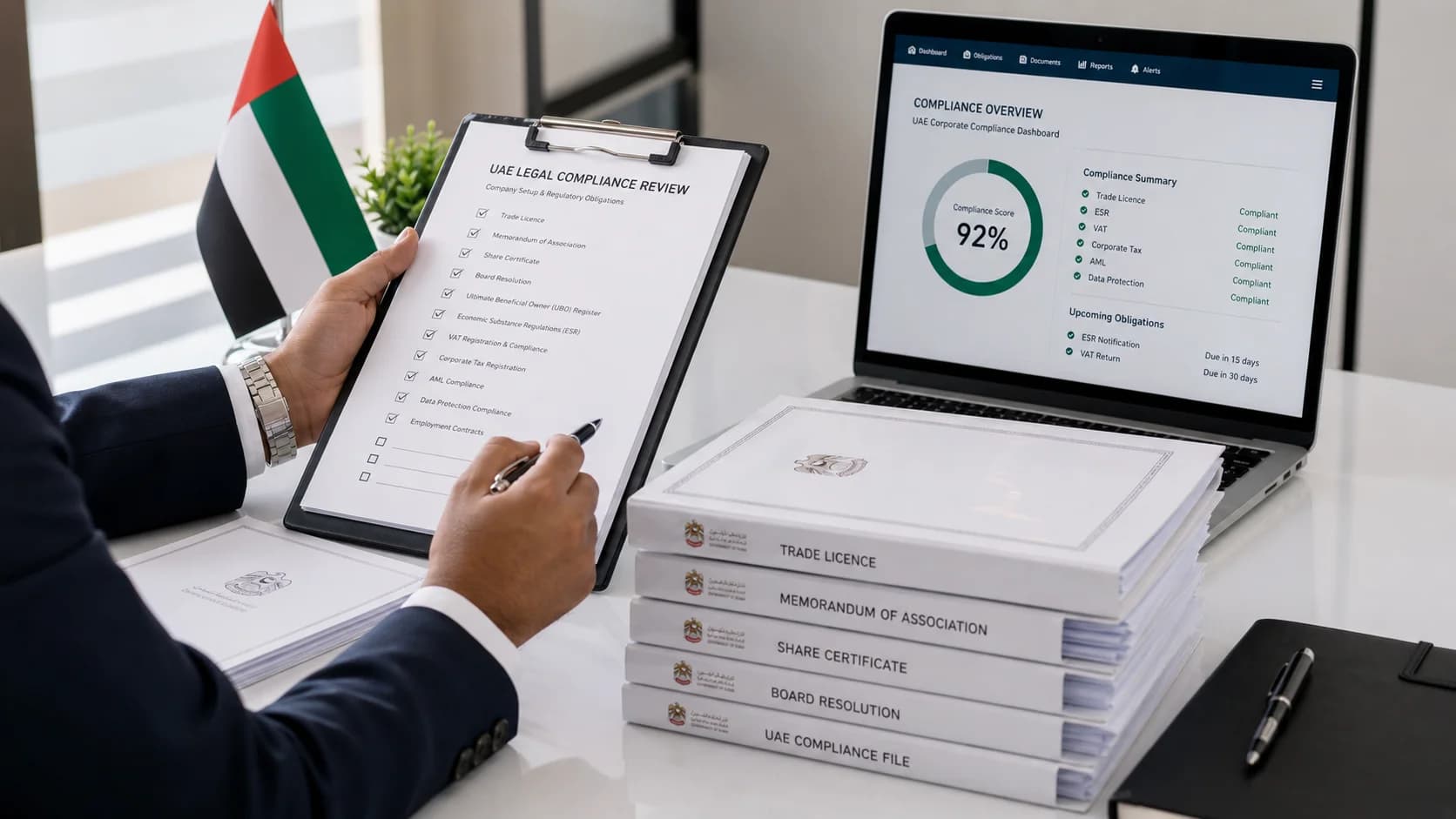
What our report covers
Every due diligence report documents both sides of the picture — what requires action and what is confirmed clean.
Red Flag Items
Issues requiring action, indemnity, or price adjustment
Outstanding FTA assessments or penalty notices not disclosed in the accounts
EOSB provision shortfall — quantified in AED against independent recalculation
UBO register not filed or not updated following shareholder changes
Employment contracts on old unlimited-term format — non-compliant post-February 2022
Undisclosed related-party loans or director drawings not reflected in accounts
Free zone share transfer restriction — prior authority approval not yet obtained
Material contracts with change-of-control clauses requiring consent on acquisition
Licensed activity scope mismatch — company conducting activities outside its scope
Pending MOHRE labour complaint or active court claim not disclosed to buyer
Economic Substance Regulations — notification or report not filed for relevant activities
Clean Bill Items
Verified and confirmed — no action required
VAT registration current and returns filed for all periods since registration date
MOHRE compliance status confirmed green; WPS submissions verified for 24 months
UBO register current, filed, and consistent with shareholder register
All employment contracts on current limited-term MOHRE format
Audited financial statements reconcile to bank statements across all accounts
Trade licence current, activity scope matches operations conducted, no outstanding fines
No pending MOHRE labour complaints, court claims, or regulatory investigations
Corporate tax registration in place; provisions adequate for financial years in scope
All sector-specific approvals (MOH, DHA, KHDA, SCA) current and consistent with operations
Lease agreements current with valid Ejari registration; no undisclosed premises liabilities
Who needs due diligence
Any party entering a UAE transaction with material risk exposure should commission independent due diligence before completing.
Acquiring Companies (M&A)
A buyer acquiring a UAE company — whether through a share purchase, business transfer, or merger — assumes full responsibility for every liability in the target entity from the completion date. Without verified due diligence, an acquirer can inherit outstanding FTA penalties, under-provisioned EOSB obligations, and undisclosed litigation with no contractual remedy against a seller who has already received their purchase consideration.
Investors (PE, VC & Angel)
Private equity and venture capital investors entering a UAE business for the first time need independent verification that the company's financial performance is as represented and that no compliance gaps exist that would impair a future exit. Angel investors and family office investors, who often move quickly on UAE transactions, are particularly exposed to the risk of undisclosed liabilities that only become visible after investment.
Joint Venture Partners
A joint venture involves shared liability and shared governance. Due diligence before forming a UAE JV must verify the partner entity's regulatory standing, its relationship with government authorities, and whether its existing commitments — licences, contracts, visa quotas — are compatible with the proposed joint venture structure. A JV partner with an unresolved MOHRE compliance issue can block the joint venture's own work permit applications from the day the entities are linked.
Banks & Lenders
UAE commercial banks and finance institutions conducting credit due diligence require independent verification of the financial position, asset quality, and regulatory standing of the borrower. Our reports support bank credit committee review, and we regularly work alongside lending institutions' legal teams on transaction-specific engagements. Our PRO and corporate services team assists with related corporate requirements arising in connection with financing transactions.
Sellers (Vendor Due Diligence)
A seller commissioning their own due diligence before going to market gains significant advantages: it identifies issues that would emerge in a buyer's process and allows the seller to address them in advance, it accelerates the transaction timeline by providing buyers with a pre-verified data room, and it substantially reduces the risk of a deal collapsing or being repriced late in the process on findings the seller could have managed proactively.

Pricing guide
All fees are professional service fees quoted as a fixed price for the agreed scope. Third-party costs — court record searches, authority verification fees, specialist legal opinions — are charged at cost. Use our UAE cost calculator for a preliminary estimate, then contact us for a specific fee indication within one business day.
| Engagement Type | Typical Fee |
|---|---|
| Starter / Single-Stream | AED 8,000–15,000 |
| Standard Multi-Stream | AED 18,000–40,000 |
| Full Transaction | AED 40,000–85,000 |
| Complex / Group / Regulated | AED 85,000–150,000+ |
Fees are indicative as of 2026 based on typical engagement scope. Scope extensions are quoted separately. Verify requirements directly with our team before engaging.
Request a Fee IndicationResults from our due diligence practice
AED 4.2M
total undisclosed liabilities identified across 18 M&A engagements in 24 months
94%
of clients avoided post-acquisition disputes after completing full due diligence
AED 890K
average FTA VAT assessment exposure identified where tax DD was absent
6 weeks
average time saved where vendor due diligence was available at transaction outset
100%
of free zone transactions reviewed contained undisclosed share transfer restrictions
AED 1.2M
EOSB and accrued leave liability in a single 35-person acquisition where HR DD was excluded from scope
Statistics are illustrative based on aggregated engagement outcomes. Individual results vary.
Five mistakes that cost buyers dearly
These are the most common due diligence errors we see in UAE transactions — and the ones that produce the largest post-acquisition disputes.
Skipping tax DD because the company is "VAT exempt"
Many UAE businesses — including free zone entities with zero-rated status — still have VAT filing obligations, import VAT liabilities, and Corporate Tax obligations entirely separate from their VAT treatment. A buyer who accepts a representation of "no tax exposure" without independent verification has no recourse when the FTA issues an assessment after completion.
Not checking free zone share transfer restrictions before agreeing heads of terms
Every major UAE free zone requires the authority's prior written consent before a share transfer is effective. A share purchase agreement executed without confirming the free zone approval process can result in a legally agreed but practically unenforceable transfer — with the buyer paying completion consideration before the authority has approved the new shareholder.
Ignoring WPS and EOSB as "operational" rather than financial liabilities
EOSB is a fixed statutory obligation under Federal Decree-Law No. 33 of 2021 — it does not disappear on acquisition. If a target company has under-provisioned EOSB for three years using an incorrect formula, that shortfall is a real liability the buyer inherits on day one. A WPS non-compliance history can block the acquiring entity's work permit processing immediately post-acquisition.
Treating audited accounts as a substitute for due diligence
Statutory audits are designed to give a true and fair view for a defined period — not to identify undisclosed liabilities, off-balance-sheet arrangements, or the full range of risks a buyer must assess. Our audit and assurance services and due diligence engagements serve different purposes, and both have a role in a properly structured transaction.
Not verifying the UBO register and complete ownership chain
In transactions with multiple layers of ownership — foreign holding companies, discretionary trusts, nominee shareholder arrangements — the UBO register under Cabinet Decision No. 58 of 2020 may not accurately reflect actual beneficial ownership. A buyer who does not independently verify the ownership chain risks completing a transaction where the seller does not have clean legal title to the shares being transferred.
Frequently asked questions
How long does due diligence take for a UAE company acquisition?
What documents does the target need to provide?
What is the difference between financial due diligence and legal due diligence, and do I need both?
Can shares in a UAE free zone company be transferred freely, or are there restrictions?
What happens if red flags are found during due diligence?
How much does due diligence cost in the UAE?
Does a seller need to commission their own due diligence?
How is confidentiality managed during due diligence?
Information on this page reflects UAE due diligence practice and regulations as of May 2026. Federal Decree-Law No. 47 of 2022 (Corporate Tax), Federal Decree-Law No. 33 of 2021 (Labour Law), Federal Decree-Law No. 32 of 2021 (Commercial Companies Law), Federal Decree-Law No. 8 of 2017 (VAT), Federal Decree-Law No. 20 of 2018 (AML), and Cabinet Decision No. 58 of 2020 (UBO) are subject to amendment without notice. Free zone authority regulations are governed by each authority's own framework and should be verified directly with the relevant authority before any transaction. Fees are indicative as of 2026 and subject to change. This content does not constitute legal, financial, or regulatory advice — verify all regulatory requirements directly with the relevant UAE government authority before entering any transaction.
Ready to set up your business
the right way?
Book a free 30-minute consultation. No sales pitch, no generic advice — just an honest conversation about your situation and what options actually make sense.

Written & reviewed by
Jashvantkumar Prajapati
Founder & CEO, Avyanco Group
21+ years advising founders and investors on UAE company formation, tax structuring, and cross-border expansion. CSP Licensed by the Dubai Economic Department. Direct experience helping 11,000+ businesses across mainland, free zone, and offshore structures.