

UAE VAT at 5% has been in force since 1 January 2018. Seven years in, most businesses in the UAE are registered. Many of them are still getting it wrong.
The penalties issued by the Federal Tax Authority are rarely the result of deliberate evasion. They come from late registration, missed filing deadlines, incorrect classification of zero-rated versus exempt supplies, and input tax claims on expenses that do not qualify. These are operational errors — and they are entirely avoidable with the right advice in place from the start.
I work with UAE businesses across mainland and free zone jurisdictions on VAT registration, quarterly return filing, input tax recovery, voluntary disclosures, and FTA audit support. My approach is straightforward: I review your actual transactions, apply the correct treatment under Federal Decree-Law No. 8 of 2017, and ensure your returns reflect your real VAT position — not just what your accounting software produces.
If you have never had your VAT position independently reviewed, the chances are there is at least one area of exposure. Most businesses I work with have either an input tax issue, a classification error, or a return that has never been reconciled to the underlying records. For how VAT sits alongside your broader UAE tax obligations, see the full tax advisory overview.
Not sure if your business is VAT compliant?
A 30-minute review of your current VAT position costs nothing and takes less time than responding to an FTA query.
Review Your VAT PositionWho Must Register for UAE VAT?
The mandatory registration threshold is AED 375,000. Your obligation to register is triggered when your taxable supplies and imports exceed AED 375,000 in any 12-month period — looking back over the past 12 months or forward over the next 30 days. Both tests apply. If either is met, you must register.
The time limit to register is 20 business days from the date you exceed — or expect to exceed — the threshold. Late registration carries an AED 20,000 administrative penalty under the FTA penalties framework. That penalty is applied from the date the obligation arose, not from when you became aware of it.
Official source: UAE VAT is governed by Federal Decree-Law No. 8 of 2017 and administered by the Federal Tax Authority. Verify current thresholds, deadlines, and penalties at tax.gov.ae.
The voluntary registration threshold is AED 187,500. Registering voluntarily below the mandatory threshold makes sense in specific circumstances — primarily where your business incurs significant VAT on its own purchases and wants to recover that input tax. A business spending heavily on goods, equipment, or services from VAT-registered suppliers is leaving money on the table by remaining unregistered.
Businesses that make only exempt supplies — certain financial services, residential property (second supply onwards), bare land, local passenger transport — are not required to register and cannot register voluntarily. Non-resident businesses making taxable supplies in the UAE must register regardless of the value of those supplies. There is no threshold for non-resident registration.
Who should consider voluntary registration:
- B2B service businesses spending heavily on UAE-sourced goods or services with VAT charged by their suppliers
- Businesses that have recently commenced trading and expect to exceed AED 375,000 within the next 12 months
- Businesses seeking to improve commercial credibility — holding a TRN signals operational substance to clients and counterparties
How to Register for UAE VAT — Step by Step
VAT registration is completed through the FTA e-Services portal. Errors in the initial registration — particularly around the effective date and business activity classification — can cause problems that are time-consuming to correct later.
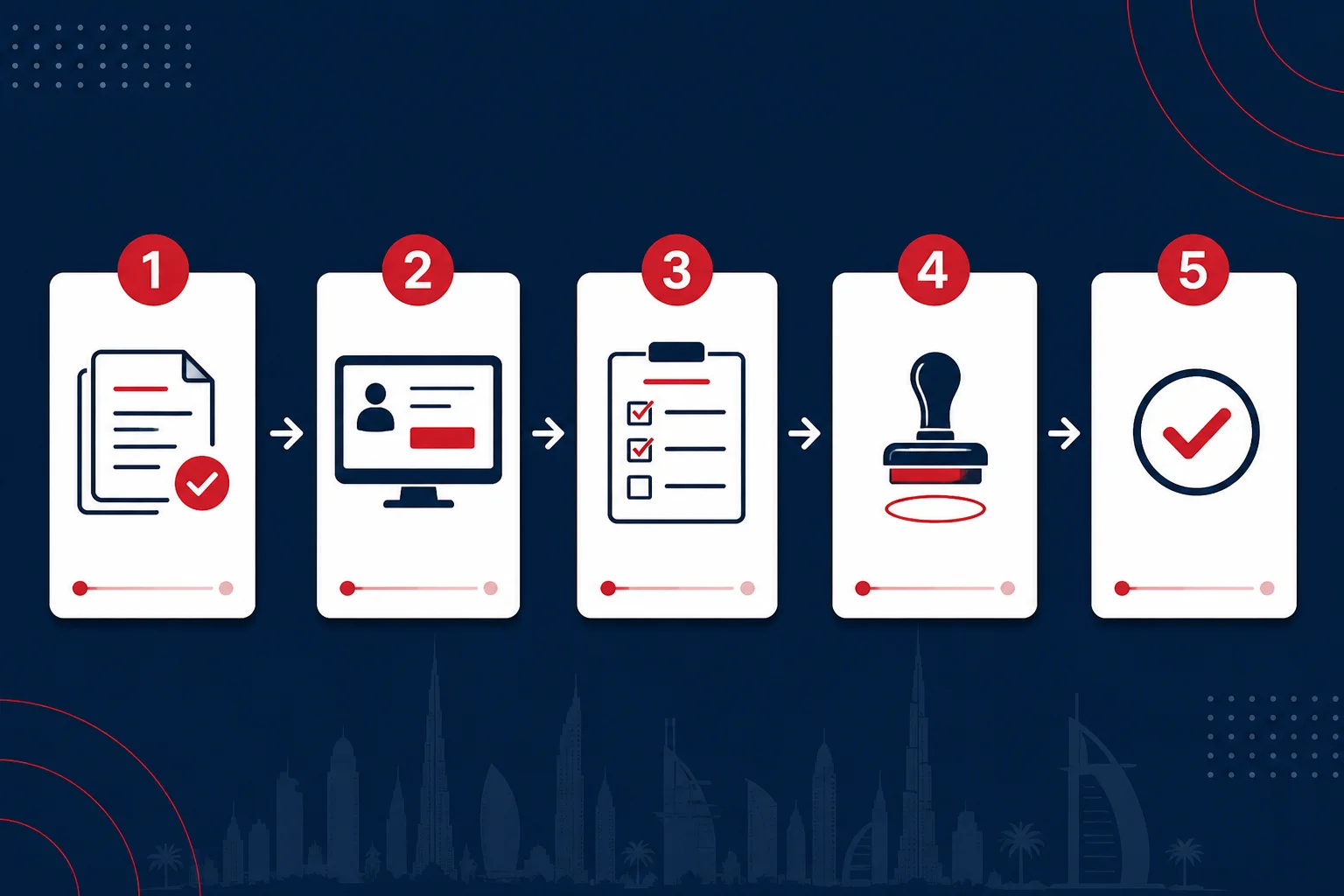
Confirm your threshold position
Review your taxable supplies and imports over the past 12 months and project forward over the next 30 days. Include all standard-rated and zero-rated supplies in the calculation. Exempt supplies do not count towards the threshold.
Gather your documentation
You will need: your trade licence, Emirates ID of the owner or authorised signatory, passport copies of all owners or partners, financial statements or sales evidence demonstrating turnover, bank account details, and details of your main business activities.
Log in to the FTA e-Services portal
Access the portal at eservices.tax.gov.ae. If you do not already have an account, create one using your business email address. The portal is also used for filing VAT returns, submitting voluntary disclosures, and managing your tax registration details.
Complete the VAT registration application
The application requires details of your legal status, primary and secondary business activities, bank account information, and your estimated turnover for the coming 12 months. You will also be asked to specify your requested effective registration date.
Upload supporting documents
Upload the documents gathered in Step 2. Ensure all documents are current, clearly legible, and match the information entered in the application. Mismatches between the trade licence and application details are a common cause of delays.
Submit and await your TRN
Once submitted, the FTA reviews your application and issues a Tax Registration Number (TRN) upon approval — typically within 20 business days of a complete and correct submission. You will receive confirmation through the portal and by email.
Display your TRN on all tax invoices
From your effective registration date, every tax invoice you issue must carry your TRN. This is a legal requirement under Cabinet Decision No. 52 of 2017. Invoices issued without a TRN are not valid tax invoices, and your customers cannot recover input VAT from them.
Quarterly VAT Return Filing

Most UAE businesses file VAT returns quarterly. Your tax period runs across three calendar months, and the filing and payment deadline is 28 days after the end of each period. For the January to March period, the deadline is 28 April. For April to June, it is 28 July. For July to September, it is 28 October. For October to December, it is 28 January of the following year. These deadlines are fixed. The FTA does not issue reminders, and there is no automatic extension.
Businesses with taxable supplies exceeding AED 150 million per year are assigned monthly tax periods by the FTA. Your VAT return reports three things: output tax (VAT you charged on your sales), input tax (VAT you paid on your business purchases), and the net liability or refund position.
Common causes of errors include: misclassifying zero-rated supplies as exempt (or vice versa), claiming input VAT on entertainment or personal expenses, applying incorrect partial exemption calculations, and submitting the figure your accounting software generates without reconciling it to your actual invoices, bank statements, and purchase records. The late filing penalty is AED 1,000 for a first offence, rising to AED 2,000 if the offence is repeated within 24 months. Late payment of VAT (separate from late filing) carries an additional penalty of 14% per annum (simple interest) under Cabinet Decision No. 129 of 2025, effective 14 April 2026.
What I do for quarterly filing:
- Reconcile your sales and purchase records to the VAT return figures before submission
- Verify that input tax claims relate to qualifying business expenses — not blocked categories
- Check supplier TRNs on purchase invoices to confirm validity before input tax is claimed
- Review the classification of each supply type against current FTA guidance
- File the return and retain confirmation records for your compliance file
Input Tax Recovery — What You Can and Cannot Claim

Input VAT is the VAT you have paid on goods and services purchased for use in your business. You are entitled to recover that VAT against your output tax liability — but only where the expense relates to taxable supplies. Taxable supplies include both standard-rated (5%) and zero-rated (0%) supplies. Input VAT that relates to exempt supplies cannot be recovered.
If your business makes both taxable and exempt supplies, you must apportion your input tax between the two categories. The standard apportionment method is based on the ratio of taxable turnover to total turnover. If the standard method does not fairly reflect your actual input tax use, you can apply to the FTA for approval of a special method. Getting partial exemption wrong results in either over-recovery or under-recovery — both of which create a liability or audit risk.
Blocked input tax categories
Entertainment expenses for customers, partners, or employees; motor vehicles used for personal purposes; and expenditure on staff benefits where the employee is not charged VAT — these cannot be recovered regardless of whether they relate to your taxable activities.
If your input tax exceeds your output tax — which occurs frequently for exporters, businesses in start-up phases, or those with large capital expenditure — you can claim a refund from the FTA. The FTA has 20 business days to process a refund claim, extendable to 40 business days in more complex cases. Recovering input VAT on an invoice where the supplier has not correctly charged VAT, or where the TRN shown is invalid, is one of the most common audit findings. Verify every TRN before making a claim.
What we check on every quarterly return:
- Every input tax claim is supported by a valid tax invoice with the supplier's TRN displayed
- No input tax has been claimed on blocked expense categories
- Partial exemption has been applied where the business makes both taxable and exempt supplies
- Export supplies claimed as zero-rated are supported by the required export documentation
- The TRN on every purchase invoice has been verified as valid via the FTA TRN checker
- The input tax figures in the return reconcile to the purchase ledger and bank statements
Voluntary Disclosure — Correcting Past VAT Errors
A voluntary disclosure is a formal submission to the FTA that corrects an error in a previously filed VAT return. It is submitted through the FTA e-Services portal as an amendment to the relevant return.
The obligation to file arises the moment you discover an error. The deadline is 20 business days from the date of discovery — not from the end of the relevant tax period, and not from your next filing date. If you discover in March 2025 that a return filed in April 2023 contained an error, you have 20 business days from that March discovery date to file the voluntary disclosure.
The penalty for a voluntary disclosure is significantly lower than the penalty applied if the FTA discovers the error first. A voluntary disclosure attracts a penalty of 5% of the difference in VAT for each year the error remained uncorrected, subject to a minimum of AED 500 and a maximum of AED 50,000. If the FTA identifies the same error through an audit or review before you disclose, the penalty is 50% of the unpaid or overclaimed VAT amount — a substantially heavier consequence.
A practical example
A UAE trading business discovered in March 2025 that it had been treating delivery charges on local orders as zero-rated when in fact they should have been classified as standard-rated at 5%. Filing a voluntary disclosure covering the affected periods — with the correct output tax calculated and the penalty paid at the voluntary disclosure rate — resolves the position cleanly. Waiting for the FTA to raise the same point in an audit would expose the business to a 50% penalty on the full underpaid amount across every affected return.
If you have identified an error in your accounting records or your filed returns, the correct course of action is immediate disclosure — not delay.
VAT Group Registration
A VAT group allows two or more UAE-resident legal entities to be treated as a single taxable person for VAT purposes. The group files one VAT return, one registration covers all members, and transactions between group members are disregarded for VAT — there is no VAT charged on inter-company invoices within the group.
To form a VAT group, the entities must be UAE-resident, must both make taxable supplies, and one entity must control the other — or a third party must control all of them. The primary benefit is operational simplicity for groups with significant intra-company transactions. Without a VAT group, each intercompany service charge, management fee, or loan arrangement potentially generates VAT that must be charged, recovered, and reconciled.
Joint and several liability
Every member of the VAT group is jointly and severally liable for the entire group’s VAT obligations. If one entity has a VAT liability it cannot pay, the FTA can pursue any other group member for the full amount. VAT grouping suits holding structures and related trading entities under common ownership — but the liability exposure must be weighed against the compliance simplification.
FTA Audit Support
The FTA has the authority to audit any UAE-registered business for up to five years from the date of the relevant tax period. If fraud is suspected, the audit window extends to 15 years. An FTA audit can be triggered by inconsistencies across your filed returns, a large or repeated refund claim, a significant deviation from industry benchmarking ratios, or random selection.
The most common findings in FTA VAT audits are: input tax claimed on blocked expense categories; export zero-rating claimed without adequate supporting documentation; purchase invoices where the supplier TRN is missing or invalid; and incorrect treatment of the boundary between zero-rated and exempt supplies.
When a business I work with receives an FTA audit notification, my approach is: first, a pre-audit health check to assess likely areas of exposure across all open tax periods; second, preparation and organisation of the documentation the FTA will request; third, management of all correspondence with the FTA during the audit process; and fourth, a formal response to any proposed adjustments, with the relevant legal basis set out clearly. An FTA audit concludes either with an assessment or with confirmation that no adjustments are required. A well-prepared response produces a materially better outcome than improvised answers submitted under time pressure.
7 Common VAT Mistakes UAE Businesses Make
Registering late after exceeding the threshold
The 20 business day registration window runs from the date you exceeded — or expected to exceed — the AED 375,000 threshold. Many businesses register only after trading at well above the threshold for months or even years. The AED 20,000 late registration penalty applies from the date the obligation arose, and the FTA can assess output tax on the unregistered period.
Treating zero-rated and exempt supplies as the same category
Zero-rated supplies are taxable supplies charged at 0% — you charge no VAT, but you can recover all related input VAT. Exempt supplies are outside the VAT system entirely — you charge no VAT, and you cannot recover input VAT that relates to them. Treating exempt supplies as zero-rated results in input tax overclaiming. Treating zero-rated supplies as exempt results in understated output tax and under-recovery — both generate a liability.
Claiming input VAT on entertainment and personal expenses
Entertainment expenses — whether for clients, staff, or business partners — are blocked for input tax recovery. So are motor vehicles acquired for purposes that are not exclusively business-related. This is one of the most frequent audit findings and is straightforward for the FTA to identify from invoice records.
Issuing tax invoices with missing mandatory fields
A valid UAE tax invoice must include the supplier's TRN, the date of supply, a sequential invoice number, the customer's name and address, a description of goods or services, quantity and unit price, the VAT amount shown separately, and the total amount payable. An invoice that omits any of these fields is not a valid tax invoice. Your customer cannot recover input VAT from an invalid invoice.
Not retaining VAT records for the required period
All VAT records — invoices, contracts, import documents, bank statements, and return reconciliations — must be retained for a minimum of five years. For real property transactions, the retention period is 15 years. Businesses that cannot produce records during an FTA audit face penalties of AED 10,000 to AED 50,000, in addition to any tax assessment on the underlying transactions.
Ignoring the voluntary disclosure window after discovering an error
The 20 business day voluntary disclosure deadline is strict. Businesses that discover a return error and delay acting — because the error is sensitive, the process is unfamiliar, or the business hopes the issue will not be raised — are accumulating risk. The longer the delay, the higher the probability that the FTA identifies the same error independently, at which point the 50% penalty rate applies.
Assuming free zone businesses are automatically VAT-exempt
Qualifying Free Zone Person status under UAE Corporate Tax law does not create an exemption from VAT. Free zone businesses making taxable supplies in the UAE are required to register, charge output tax, and file returns on exactly the same basis as mainland businesses. QFZP status is a Corporate Tax concept. It has no bearing on your VAT obligations.
Found an error in your past VAT returns?
You have 20 business days from discovering an error to file a voluntary disclosure — acting within that window keeps your penalty at the voluntary disclosure rate rather than the audit rate.
WhatsApp Us NowVAT questions specific to your business?
Every business structure has its own VAT complexities — book a free call and I will give you a direct answer based on your actual situation.
Schedule a Free Call