

The most expensive mistake in UAE company formation is not the formation itself — it is the wrong structure chosen at the start. A business set up in the wrong jurisdiction, with the wrong licence category, or without proper consideration of post-setup compliance, creates problems that compound over time. Fixing a bad setup typically costs more than the original formation. I have seen it hundreds of times across 21+ years of advisory work.
Choosing between mainland, free zone, and offshore is not a question with a single right answer. The correct structure depends on who your customers are, what activities your business conducts, whether you need UAE residency visas, and what your tax and compliance obligations look like after incorporation. A formation agent who tells you the answer without asking those questions first is not giving you advice — they are selling you a product.
"Businesses that start correctly spend significantly less on compliance, restructuring, and penalty resolution over their operating lifetime."
I have assisted 11,000+ companies through business setup across mainland and free zone jurisdictions. My approach is to identify the structure that works for your business model — not the one with the lowest headline government fee. For a full overview of advisory services available after incorporation, see the full tax advisory overview.
Not sure which structure is right for you?
Book a free 30-minute call and I will tell you which jurisdiction fits your business activity, customer base, and compliance requirements — before you commit to any formation package.
Find the Right Licence for YouMainland, Free Zone, or Offshore — Which Structure Fits?
These three structures serve fundamentally different purposes. The right answer is determined by your customers, your activities, and your compliance goals — not by which has the lowest headline cost.
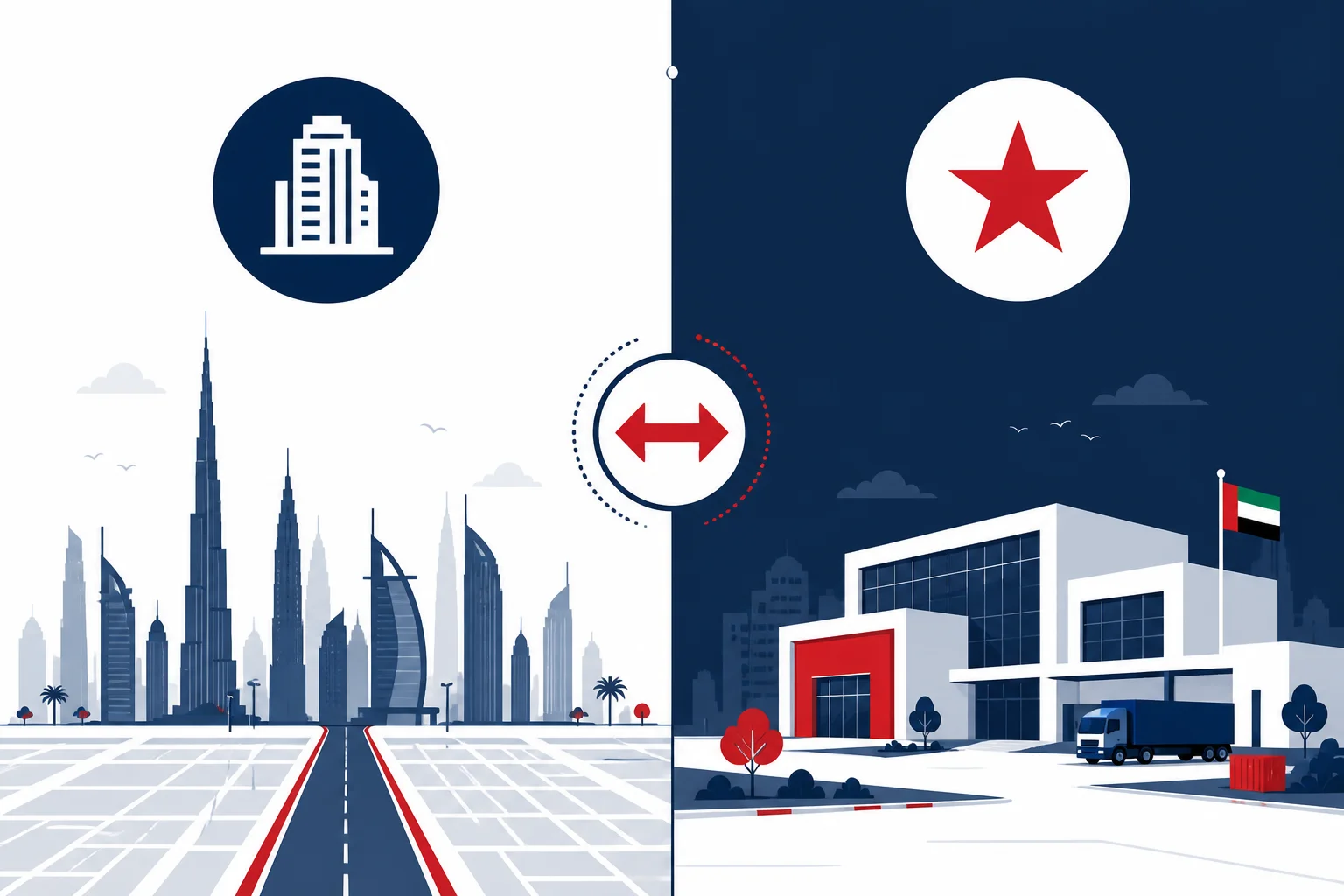
Mainland
Best for: UAE customers, regulated activities, government contracts
- Trade anywhere in the UAE without restriction
- 100% foreign ownership (most activities) since 2021
- Physical ejari-registered office required
- External approvals needed for regulated sectors
- Visa allocation tied to office square footage
Free Zone
Best for: International clients, export, lean cost structure
- Cannot sell directly to UAE mainland customers
- 100% foreign ownership in all free zones
- Faster setup: 4–7 working days
- Flexi-desk satisfies office requirement
- Fixed visa allocation per package
⚠ Corporate Tax at 9% applies — free zone ≠ tax exempt
Offshore
Best for: Asset holding, international trading, no UAE operations
- Cannot conduct business inside the UAE
- No physical UAE office required
- Used for holding structures and asset protection
- RAK ICC or JAFZA offshore registration
- Setup in 3–5 working days
⚠ CT registration obligations depend on structure — specific advice required
The tax misconception that costs businesses most
Both mainland and free zone companies are subject to UAE Corporate Tax at 9% on taxable income above AED 375,000, and must register with the FTA. The 0% rate available to Qualifying Free Zone Persons under Ministerial Decision No. 73 of 2023 is conditional on meeting specific income, substance, and compliance requirements — it is not automatic. VAT under Federal Decree-Law No. 8 of 2017 applies equally to both once the AED 375,000 threshold is exceeded. See the Corporate Tax Advisory page for details.
Dubai and UAE Free Zone Comparison
45+ free zones operate across the UAE. These are the ones most businesses will consider — with an honest assessment of who each suits.
Consistently the most cost-effective Dubai free zone for businesses wanting a Dubai address, flexible activity list, and straightforward setup. Standard packages include a flexi-desk and visa allocation. Suits consultants, service businesses, trading companies, and first-time UAE entrants with a lean cost structure.
A premium free zone with strong credibility in commodities, trading, fintech, and digital assets. The DMCC framework for virtual assets and crypto makes it the preferred jurisdiction for blockchain-related businesses. Higher licence and visa costs — not the right choice if cost minimisation is the primary objective.
Operates under English common law with its own courts and the DFSA as independent regulator. The appropriate jurisdiction for financial services firms, fund managers, family offices, and professional services businesses serving institutional clients. Cost is at the top end of the UAE free zone market.
The established choice for logistics, warehousing, manufacturing, and trading businesses requiring proximity to Jebel Ali port. Suits businesses with physical goods moving through the UAE. The port location is the primary commercial driver for choosing JAFZA over other free zones.
A Dubai address at a lower cost point than DMCC or DIFC. Suits technology, media, and service businesses wanting a central Dubai base without premium free zone pricing. A practical option for small businesses and start-ups.
Based in Ras Al Khaimah — approximately 75 km north of Dubai, not in Dubai itself. One of the most cost-effective free zone options in the UAE; permits manufacturing activities. The lower cost reflects the location outside Dubai. For businesses where address is not a commercial consideration, RAKEZ is a genuinely low-cost entry point.
Abu Dhabi's English common law jurisdiction with its own courts and the FSRA as regulator. The Abu Dhabi equivalent of DIFC — appropriate for financial services, funds, and family offices. Not in Dubai; cost profile is comparable to DIFC.
How to Set Up a Business in Dubai — A 6-Step Process
From activity definition through to bank account — the complete sequence, with what to expect at each stage.
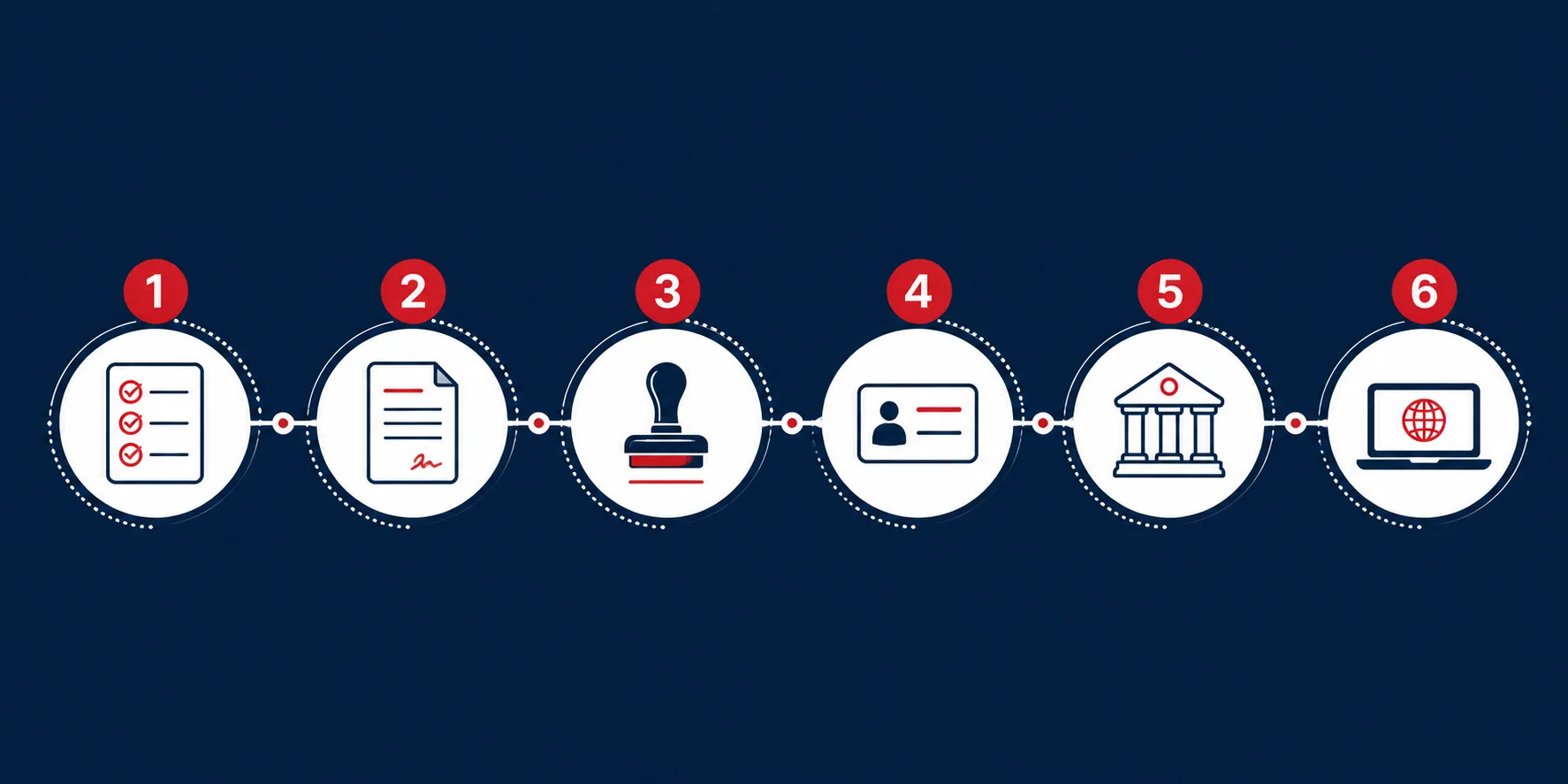
Define your business activity and legal structure
Your business activity determines your licence category — commercial, professional, or industrial — which jurisdiction will approve it, and whether external regulatory approvals are required before a licence can be issued. Healthcare businesses need Dubai Health Authority approval. Education businesses need KHDA sign-off. Food businesses need Dubai Municipality clearance. Financial services may need DFSA or Central Bank authorisation. Identifying these requirements before you begin prevents delays and avoids applying to the wrong authority.
Choose your jurisdiction
Based on your activity, customer base, visa requirements, and compliance budget, you select between mainland DET, a specific free zone, or offshore. This decision shapes every subsequent step — the wrong jurisdiction at this stage is difficult and costly to unwind.
Reserve your trade name and submit your application
Trade name reservations are made through DET for mainland companies and through the relevant free zone authority for free zone entities. Once approved, the formation application and supporting documents are submitted to the licensing authority.
Obtain your trade licence
For most mainland activities, DET issues a trade licence within 7–15 working days of a complete application. Free zone licences typically issue within 4–7 working days. The Memorandum of Association — for LLCs — is executed at this stage.
Apply for investor and employment visas
With your licence issued, apply for investor visas for shareholders and employment visas for staff. Your visa quota is set by office space on mainland (approximately one visa per 9 sqm) or by your package on free zones. Emirates ID registration follows visa issuance — the full process from licence to Emirates ID typically takes three to five weeks.
Open a UAE business bank account
Bank account opening is separate from formation and takes four to eight weeks. Submit your trade licence, Memorandum of Association, shareholder documents, company profile, and source of funds explanation. I assist with bank selection and application preparation — but account approval is the bank's decision.
Post-Setup Compliance — What Happens After Your Licence
The trade licence is the beginning of your compliance obligations, not the end. Most businesses I work with significantly underestimate how much is required after incorporation — and most of these obligations have their own deadlines and penalties.
Corporate Tax Registration
Mandatory for all UAE businesses — mainland and free zone, profitable or not. Register via FTA EmaraTax within 3 months of your first CT financial year. Penalty: AED 10,000 for late registration.
CT Advisory →VAT Registration
Mandatory when taxable supplies exceed AED 375,000 in any 12-month period. Voluntary registration available from AED 187,500. Penalty for late registration: AED 20,000.
VAT Advisory →UBO Register Filing
Mandatory under Cabinet Decision No. 58 of 2020. All UAE companies must maintain and file a register of Ultimate Beneficial Owners with the relevant authority.
ESR Annual Notification
Required if your business conducts relevant activities: banking, insurance, IP, shipping, holding company, HQ, distribution and service centre, investment fund management, or lease-finance.
ESR Compliance →MOHRE Registration & WPS
Register with the Ministry of Human Resources and Emiratisation before hiring any employee. Wages must be paid through the Wage Protection System — non-compliance suspends your ability to process new visas.
Annual Licence Renewal
Trade licence renewal is required every 12 months, along with renewal of any regulatory approvals (DHA, KHDA, DFSA etc.), office lease, and any visa-related renewals.
Opening a UAE Business Bank Account
Bank account opening is the step that surprises most new business owners. It is not included in standard formation packages, it is not a formality, and four to eight weeks is a realistic timeline — not a worst-case scenario. UAE banks conduct full KYC and AML reviews on every new business account. They review your trade licence, MoA, shareholder documents, company profile, expected transaction volumes, and source of funds.
Traditional UAE Banks
- Emirates NBD, ADCB, First Abu Dhabi Bank, Mashreq
- Full-service accounts with trade finance and multi-currency
- 4–8 week account opening timeline
- Minimum balance requirements and monthly fees apply
- Best for established businesses with clear transaction history
Fintech & Challenger Banks
- Wio, Pyypl, Nomo and similar platforms
- Faster digital onboarding — sometimes within days
- Lower minimum balances
- Limitations on cash handling and international wire processing
- Practical for smaller businesses in early trading phase
The single most effective preparation step
Before approaching any bank, prepare a clear one-page company profile that explains what your business does, who your customers are, where your revenue comes from, and how transactions will flow through the account. This document resolves the most common cause of bank account delays. I assist clients with bank selection and application preparation — but the approval decision rests with the bank.
What Does Business Setup in Dubai Cost?

Budget
RAKEZ, IFZA
Lowest government fees. Flexi-desk included. Suits cost-conscious businesses where address is not a commercial factor.
Mid
Meydan, comparable Dubai FZs
Dubai address at moderate cost. Suitable for service businesses, consultants, and trading companies.
Premium
DMCC, DIFC, ADGM
Higher licence cost with corresponding address credibility and specialist regulatory framework.
Mainland
DET Dubai
Cost driven by office space and activity type. Significant variation by activity, location, and any external approvals required.
What advertised prices do not include
Most formation package prices exclude: Emirates ID fees, medical insurance for visa applicants, visa stamping fees, bank account opening charges, and ongoing compliance costs — Corporate Tax filing, VAT returns, ESR notifications, and annual accounting. These costs are real and recurring. Budget for them before comparing formation packages. Use the cost calculator to build a realistic total-cost picture for your specific structure.
6 Common Business Setup Mistakes in Dubai
Choosing a free zone to avoid corporate tax
UAE Corporate Tax at 9% applies to all UAE businesses — mainland and free zone. The 0% rate available to Qualifying Free Zone Persons is conditional on meeting specific income, substance, and compliance criteria. It is not automatically granted to every free zone entity, and most businesses that trade with mainland UAE customers do not meet the qualifying income test. Setting up a free zone company on the assumption that it will pay no tax is one of the most costly misconceptions in UAE company formation today.
Applying without checking for external regulatory approvals
Healthcare businesses require Dubai Health Authority approval. Education businesses require KHDA approval. Food businesses require Dubai Municipality sign-off. Financial services may require DFSA or Central Bank authorisation. Applying for a licence without confirming these requirements first results in delays, rejected applications, and wasted formation fees.
Setting up without accounting for post-setup compliance costs
The formation fee is a one-time cost. Corporate Tax registration, annual CT filing, VAT returns, ESR notifications, UBO filings, MOHRE registration, and WPS compliance are recurring. Businesses that budget only for formation miss the ongoing cost entirely — which can be as significant as the original formation fee each year.
Underestimating bank account opening timelines
Four to eight weeks is realistic for a UAE business bank account. Businesses that plan to start trading immediately after licence issuance are routinely delayed because they have not started the bank application early enough. Start the process the same week your licence is issued.
Not planning visa requirements before choosing your office
Your visa quota is tied to your office space. On mainland, approximately one visa per 9 sqm is the standard allocation. On free zones, the visa allocation is fixed to your package. Businesses that set up without considering how many people they need to sponsor frequently need to upgrade their office or change their package shortly after formation.
Using an unregistered or unaccountable formation agent
A formation agent who is not registered with the relevant authorities, does not hold a CSP licence from MOHRE, and does not carry professional indemnity insurance offers you no protection if your formation is filed incorrectly. Errors in the initial formation are your problem to fix, not theirs. Work with a licensed, accountable professional.
Avoided these mistakes — but not sure you've covered everything?
A structure review takes 30 minutes and identifies any gaps in your current setup before they become compliance problems.
WhatsApp Us NowCelebrity Client
Ready to set up your Dubai company?
Book a free consultation and I will give you a clear, jurisdiction-specific recommendation based on your business activity and objectives — before you sign anything.
Find the Right Licence for You