

Need expert help with this? View our advisory service →
The first UAE corporate tax returns came due in 2025. For the many businesses on a calendar year, the return for the 2025 financial year is due by 30 September 2026 — and for a lot of them it is their first ever filing. Registration was the easy part; the return is where it gets real. This is a practical guide to filing: the deadline, what you need, the EmaraTax steps, the elections that are easy to miss, and the penalties for getting it wrong — plus one date that beats 30 September if this is your first return.
The deadline that matters
Your corporate tax return must be filed, and the tax paid, within nine months of the end of your tax period. For a financial year ending 31 December 2025 that is 30 September 2026; for a 30 June 2025 year-end it was 31 March 2026. Filing the return and paying the tax are two separate obligations, but they share that single nine-month deadline.
A few practical points that catch people out. You file one return per tax period — there are no advance instalments. There is no general extension to the 30 September 2026 date. And because a bank transfer can take days to clear, treat the deadline as money actually in the FTA's account, not payment merely initiated — a transfer that lands late still triggers the late-payment penalty, so pay several days early.
The earlier deadline first-time filers should know
This is the tip most first-timers miss, and it is worth AED 10,000. If this is your first tax period and you registered late — or want to be safe about the AED 10,000 late-registration penalty — the FTA will waive that penalty if you file your first return within seven months of the end of your first tax period, instead of the usual nine.
For a first period ending 31 December 2025, that means filing by 31 July 2026, not 30 September. If you have already paid the AED 10,000 and you meet the condition, it is refunded to your account. So for a first-year filer the real target date can be two months earlier than the headline deadline — and skipping it is an avoidable AED 10,000 mistake.
Who actually has to file — yes, even at 0%
Every registered taxable person files a return. It is registration that creates the obligation, not the amount of tax due — so you file even when you expect to pay nothing. That includes a business with taxable income under the AED 375,000 threshold, a Qualifying Free Zone Person on the 0% rate, a company that has elected Small Business Relief, and even a dormant company, which files a nil return.
There is no "nil return" exemption: zero tax does not remove the duty to file. And if you are part of a tax group, you file a single consolidated return for the whole group — a point some entities miss by filing separately and creating a mess to unwind.
What you need before you open EmaraTax
Get the inputs ready before you start. You need your financial statements for the period, prepared on the correct basis; your corporate tax registration number; and the records behind the figures. On the accounts, the rules changed in 2025: under Ministerial Decision No. 84 of 2025, audited financial statements are mandatory if your revenue is over AED 50 million, for every Qualifying Free Zone Person regardless of revenue, and — newly — for all tax groups.
The default accounting basis is accrual under IFRS; a cash basis is only allowed if your revenue is AED 3 million or less. Your IFRS financial statements are uploaded with the return, so they need to be final and signed off, not a draft you are still adjusting.
Filing on EmaraTax, step by step
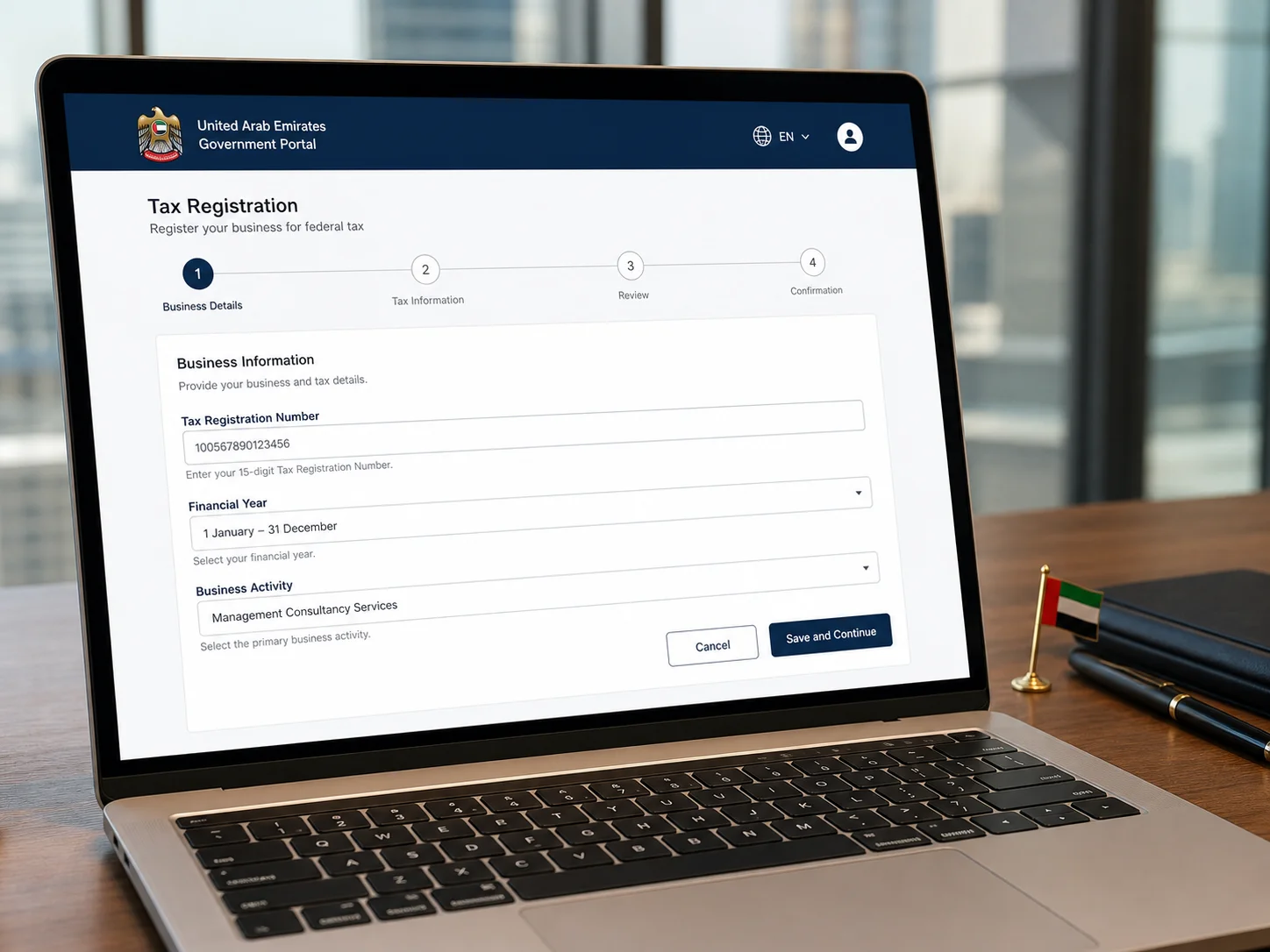
The return is filed electronically on the FTA's EmaraTax portal, and the FTA's Corporate Tax Returns Guide is the authoritative walk-through. In outline: log in, open the Corporate Tax tile, and select the return for your tax period. Confirm your taxable-person type and accounting basis, then enter revenue and accounting income from your financial statements.
From there you declare any exempt income and work through the adjustments that move accounting profit to taxable income, make your elections, apply any brought-forward tax losses, and complete the schedules the portal presents. EmaraTax is adaptive — it shows only the schedules relevant to you, though that can still run to many for a complex business. You upload the financial statements, review the summary, submit, and pay.
From accounting profit to taxable income
The return is not simply your profit figure with 9% applied to it. UAE corporate tax starts from your IFRS accounting net profit and then makes statutory adjustments — adding back non-deductible items, removing exempt income such as qualifying dividends, applying the interest-deduction limits, and so on. Brought-forward tax losses can be offset, but only up to 75% of the taxable income of the period.
This reconciliation is the heart of the return, and the part most worth having professional eyes on. An error here changes the tax you actually pay, and it is precisely what the FTA scrutinises — a clean, well-documented computation is your best protection in any later query.
The elections you must not forget
Some of the most valuable outcomes are things you actively elect in the return — miss the election and you lose the benefit for that period. Small Business Relief is the clearest example: if your revenue is AED 3 million or less you can elect to be treated as having no taxable income, but only for tax periods ending on or before 31 December 2026, and only if you claim it. Qualifying Free Zone Person status likewise has to be confirmed, not assumed.
One important caution on Small Business Relief: electing it disapplies your ability to carry forward tax losses. So a low-revenue business sitting on losses it wants to use in future is sometimes better off not electing. Run the numbers before you tick the box, rather than reaching for the relief automatically.
Do not forget the transfer-pricing disclosure
Related-party dealings are declared inside the return, and the thresholds catch more businesses than people expect. Under Ministerial Decision No. 97 of 2023, you must file a transfer-pricing disclosure form with your return if your aggregate related-party transactions exceed AED 40 million, with per-category disclosure where a category exceeds AED 4 million, and payments to connected persons above AED 500,000 are disclosed too.
Separately, full transfer-pricing documentation — a master file and a local file — is required where revenue reaches AED 200 million or you are part of a large multinational group. The point founders miss: even wholly domestic groups have related-party transactions, so this is not just an international-business concern.
The penalties for getting it wrong
The figures are set by Cabinet Decision No. 75 of 2023. Filing the return late costs AED 500 for each month, or part of a month, for the first twelve months, then AED 1,000 a month after that. Paying late is a separate penalty of 14% per year, charged monthly on the unpaid tax from the day after the deadline.
One clarification, because it is widely muddled: that 14% is the corporate tax late-payment rate and it has not changed — the "2% immediately plus 4% a month" figure some articles quote belongs to VAT and excise, not corporate tax. An incorrect return is AED 500, waived if you fix it before the deadline, and correcting an error later through a voluntary disclosure adds 1% a month on the difference. The pattern is simple: cheap if you are early, expensive if you drift.
Getting it right the first time
The businesses that file cleanly are the ones that start early, close their accounts properly, and treat the elections and disclosures as decisions rather than boxes. The recurring first-year mistakes are all avoidable: assuming a 0% or nil position removes the duty to file; using the calendar year when your financial year is actually different; forgetting to elect Small Business Relief or confirm free-zone status; missing the transfer-pricing disclosure; and paying at the last minute only for the transfer to clear late.
If this is your first return, or your structure has any complexity — free-zone income, a tax group, significant related-party dealings — it is worth doing with support rather than discovering a problem after submission. We prepare and review UAE corporate tax returns end to end: the accounts, the reconciliation, the elections, the disclosures, and the filing itself. Book a consultation before the deadline and we will make sure your return is right, not just on time. This article is general information, not tax advice — confirm your position for your specific circumstances.
Frequently asked questions
When is the UAE corporate tax return due?
The return must be filed, and the tax paid, within nine months of the end of your tax period. For a financial year ending 31 December 2025 that is 30 September 2026; for a 30 June 2025 year-end it was 31 March 2026. Filing and payment share that single deadline. There is no general extension, and because bank transfers take time to clear, pay several days early.
Do I have to file a corporate tax return if my business pays 0%?
Yes. Registration creates the filing obligation, regardless of how much tax is due. A business under the AED 375,000 threshold, a Qualifying Free Zone Person on the 0% rate, a company that elected Small Business Relief, and even a dormant company must all file — there is no nil-return exemption. Tax groups file a single consolidated return.
How do I file a corporate tax return in the UAE?
Electronically, through the FTA's EmaraTax portal. You log in, open the Corporate Tax return for your tax period, confirm your taxable-person type and accounting basis, enter revenue and accounting income, declare exempt income and adjustments, make your elections, apply any tax losses, complete the schedules shown, upload your financial statements, review, submit, and pay. The FTA's Corporate Tax Returns Guide is the authoritative walk-through.
What documents do I need to file my corporate tax return?
Your financial statements for the period, your corporate tax registration number, and the records supporting the figures. Audited financial statements are mandatory if revenue exceeds AED 50 million, for every Qualifying Free Zone Person, and for all tax groups; the default basis is accrual under IFRS, with cash basis allowed only up to AED 3 million revenue. Your IFRS statements are uploaded with the return, so they must be final.
What are the penalties for filing or paying corporate tax late?
Late filing is AED 500 for each month (or part) for the first twelve months, then AED 1,000 a month. Late payment is a separate 14%-per-year penalty charged monthly on the unpaid tax from the day after the deadline — this is the corporate tax rate; the "2% plus 4%" figure some cite belongs to VAT and excise. Late registration is a one-off AED 10,000, and an incorrect return is AED 500 (waived if corrected before the deadline).
Can I still get the AED 10,000 late-registration penalty waived?
Yes, under the FTA's waiver initiative, if you file your first corporate tax return within seven months of the end of your first tax period, instead of the usual nine. For a first period ending 31 December 2025 that means filing by 31 July 2026. If you already paid the AED 10,000 and meet the condition, it is refunded to your account — a strong reason for first-time filers to file early.
Do I need to elect Small Business Relief in the return?
Yes — it is not automatic. If your revenue is AED 3 million or less you can elect, in the return, to be treated as having no taxable income, but only for tax periods ending on or before 31 December 2026, and only if you claim it. Note that electing it disapplies tax-loss carry-forward, so a low-revenue business with losses is sometimes better off not electing — check before ticking the box.
Share this article
Need personalised advice?
Book a free 30-minute consultation with Jashvantkumar Prajapati — 21+ years in UAE business advisory.
Book a Free Consultation